Cart
No products in the cart.
Most people think they know their size until one brand fits perfect, another crushes their toes, and a third feels like a canoe. That is exactly why knowing how to find shoe size matters. Not the size you always buy. Your actual size, right now, for the kind of shoe you want to wear.
A lot of bad sneaker purchases start with blind confidence. You order your usual size, hope for the best, and then spend a week deciding whether the tight toe box will somehow stretch into a miracle. Sometimes it does a little. Usually it does not. We would rather get it right before the box shows up.
You do not need fancy gear. A sheet of paper, a pen, socks you would actually wear with the shoes, and a ruler or measuring tape will do the job.
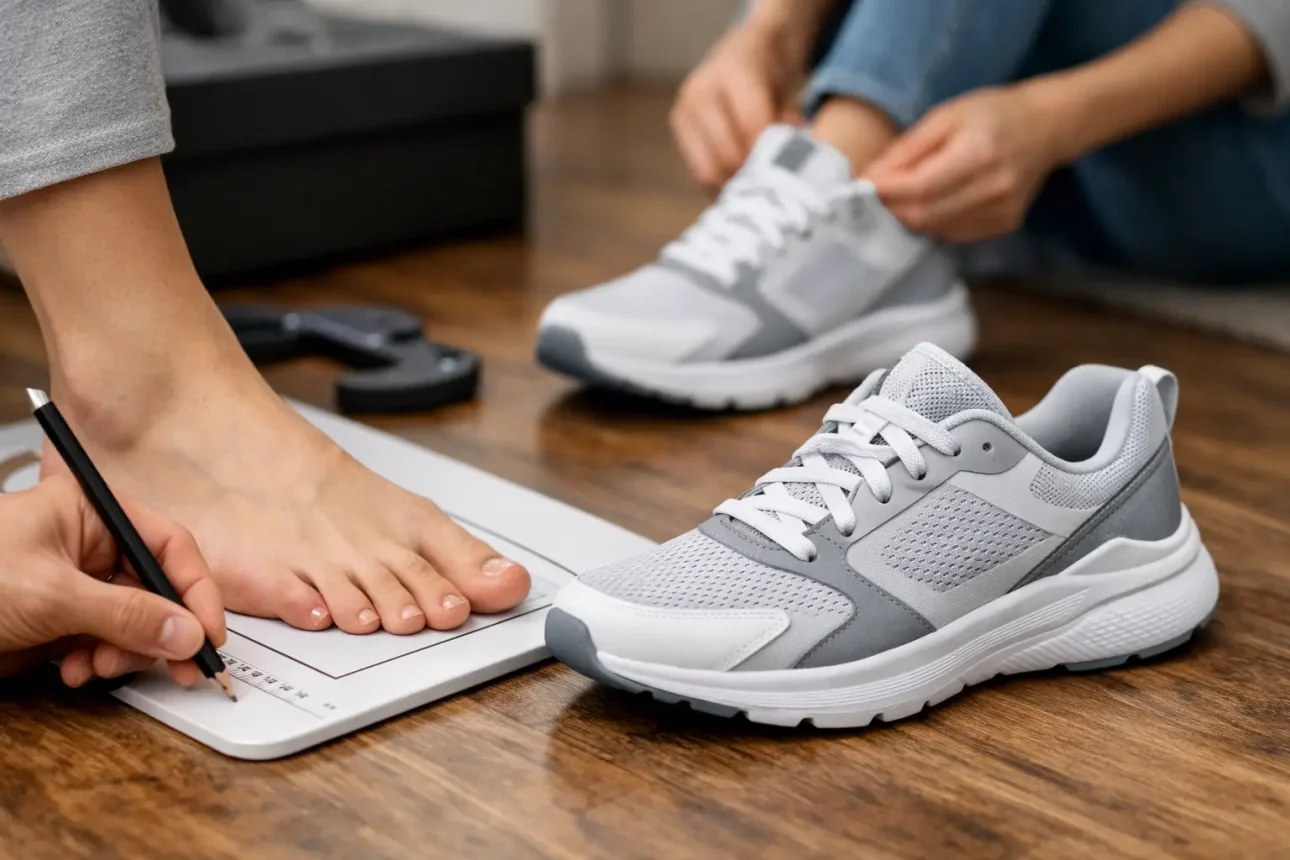
Put the paper on a hard floor, not carpet. Stand on it with your full weight on both feet. That part matters. Feet spread when you stand, and measuring while sitting can leave you half a size off. Trace around each foot or mark the very back of your heel and the tip of your longest toe. Then measure the length.
Measure both feet. Always. A lot of people have one foot slightly bigger than the other. It is normal. It is also annoying if you ignore it. Use the bigger foot as your starting point.
Do this at the end of the day if you can. Feet swell a bit after walking around, standing, living your life. If you measure first thing in the morning, your shoes can feel tighter later when you actually wear them.
Foot length is the main one. Width matters too, but most people miss it until a pair feels weird across the forefoot. If the sides of your foot push over the midsole or the upper looks strained, the issue may not be length. It may be width.
If you want a rough width check at home, wrap a tape measure around the widest part of your forefoot while standing. It is not as standardized as length, but it helps you spot whether you are narrow, average, or wide. That matters because some brands run slim on purpose, and some are naturally more forgiving.
This is where people get irritated. You measure carefully, match the chart, order the pair, and the fit is still off. That is not because measuring failed. It is because shoe sizing across brands is messy.
A Nike running shoe can fit very differently from a New Balance lifestyle model. Adidas can feel long in one line and narrow in another. Hoka often has that big cushioned shape, but the upper fit can still vary. Even within the same brand, retro sneakers and performance runners are not built the same way.
So yes, learn how to find shoe size. But also learn this: your foot size and your shoe size are related, not identical. The number on the box is useful. The shape of the shoe is what decides whether it feels good.
For most sneakers, you want a little room in front of your longest toe. Roughly a thumb’s width is a decent rule. Not a giant empty gap. Not toe-on-the-edge either.
Too short is obvious. Your toes hit the front, especially walking downhill or going downstairs. Too long is less obvious but still bad. Your heel can slip, your foot slides around, and the shoe creases in weird places. It also just feels sloppy.
A lot of people buy too small because they like a snug first try-on. Then two hours later their feet are mad. We are not saying every shoe should fit roomy, but if your toes are cramped standing still, they will not get happier once you start moving.
This is the part people blame on “break-in” when they should blame the fit. If the length feels right but the shoe squeezes the sides of your foot, do not assume it will magically become perfect. Some materials soften. Some do not. Leather can give a bit. Tough synthetic uppers usually give less than people hope.
If you are on your feet all day, skip shoes that are only comfortable while you are standing in your bedroom for thirty seconds. Real comfort shows up at 5 pm, not at unboxing.
Not every shoe should fit exactly the same. That is where a lot of confusion starts.
Running shoes usually need a bit more room up front because your feet swell when you move and your toes need space. If you run or walk long distances, that extra room is worth it. A tight running shoe is miserable fast.
Lifestyle sneakers can be a little closer-fitting, especially if the upper is soft and the shape is forgiving. But even then, too snug is still too snug. Clean look or not, numb toes are not worth it.
Court-style and retro shoes are the ones that trick people most. They often look great and feel stiff at first. Some break in nicely. Some stay pretty flat and rigid. If you already know you like cushion, do not force yourself into a hard, narrow classic just because it looks sharp in photos.
This is the honest part. Size charts help, but they do not erase how brands build shoes.
Nike often runs a bit narrow, especially in certain lifestyle and running models. Adidas can be more forgiving in some lines, but not always. New Balance usually does a better job for wider feet, which is one reason people stay loyal once they find a model that works. Asics, Brooks, and Hoka tend to make more sense for practical all-day wear, but shape still varies by model. Puma and Onitsuka Tiger can look clean and low-profile, but some pairs fit slimmer than people expect.
That does not mean one brand is better. It means brand loyalty based on one pair from five years ago is shaky logic. Check the fit, not just the logo.
This is where it depends. Annoying answer, but true.
If the shoe runs short or narrow, going up half a size is usually the safer call. If the shoe already runs long and your heel tends to slip, staying down might make more sense. Your socks matter too. Thick athletic socks can change the fit more than people think.
We usually lean toward a little extra room over a little extra squeeze, especially for everyday sneakers, walking shoes, or anything you plan to wear for hours. A shoe that is slightly roomy can often be fixed with lacing or sock choice. A shoe that is too short is just too short.
If your heel keeps lifting, your toes hit the front, the sides pinch, or you avoid wearing a pair because it annoys you after an hour, your size or fit is off. Pretty simple.
Also, do not trust the idea that discomfort means the shoe is just “premium” or needs character-building break-in time. That is sneaker nonsense. Some shoes need a couple wears to soften up. They should not feel like punishment.
If you are sizing for kids, leave a little room but not so much that the shoe becomes clumsy. Parents sometimes buy way ahead to save money, which makes sense until the kid starts tripping over giant sneakers. A bit of growing room is smart. A full size too big is usually not.
For teens, growth spurts can make old size habits useless. Measure again. Do not assume last year’s size still means anything.
The first mistake is measuring only one foot. The second is measuring while sitting. The third is assuming every size 10 fits like every other size 10. It does not.
Another bad move is trusting old shoes that already stretched out. People say, “These fit great,” while wearing a pair they have beaten into submission for eight months. That tells you almost nothing about how a fresh pair will fit.
And one more thing. Do not buy based on looks alone if you know a shape never works for your feet. Some sneakers are clean on shelf and annoying on foot. We like a sharp pair as much as anyone, but if you are walking, commuting, standing, or traveling in them, feel wins.
Try shoes on with the socks you plan to wear. Stand up. Walk around. Pay attention to heel slip, toe room, and pressure across the widest part of your foot. Those three things tell you more than the number on the box.
If one shoe feels slightly off at first, ask yourself where. Heel? Toe? Width? General stiffness? That is how you tell whether you need a different size, a different width, or just a different model. People waste a lot of time trying to force the wrong shoe to become the right one.
Knowing how to find shoe size is really about knowing your feet and being honest about fit. Not optimistic. Not nostalgic. Honest. Once you do that, buying sneakers gets a lot easier, and the pairs you keep are the ones you actually want to wear.