Cart
No products in the cart.
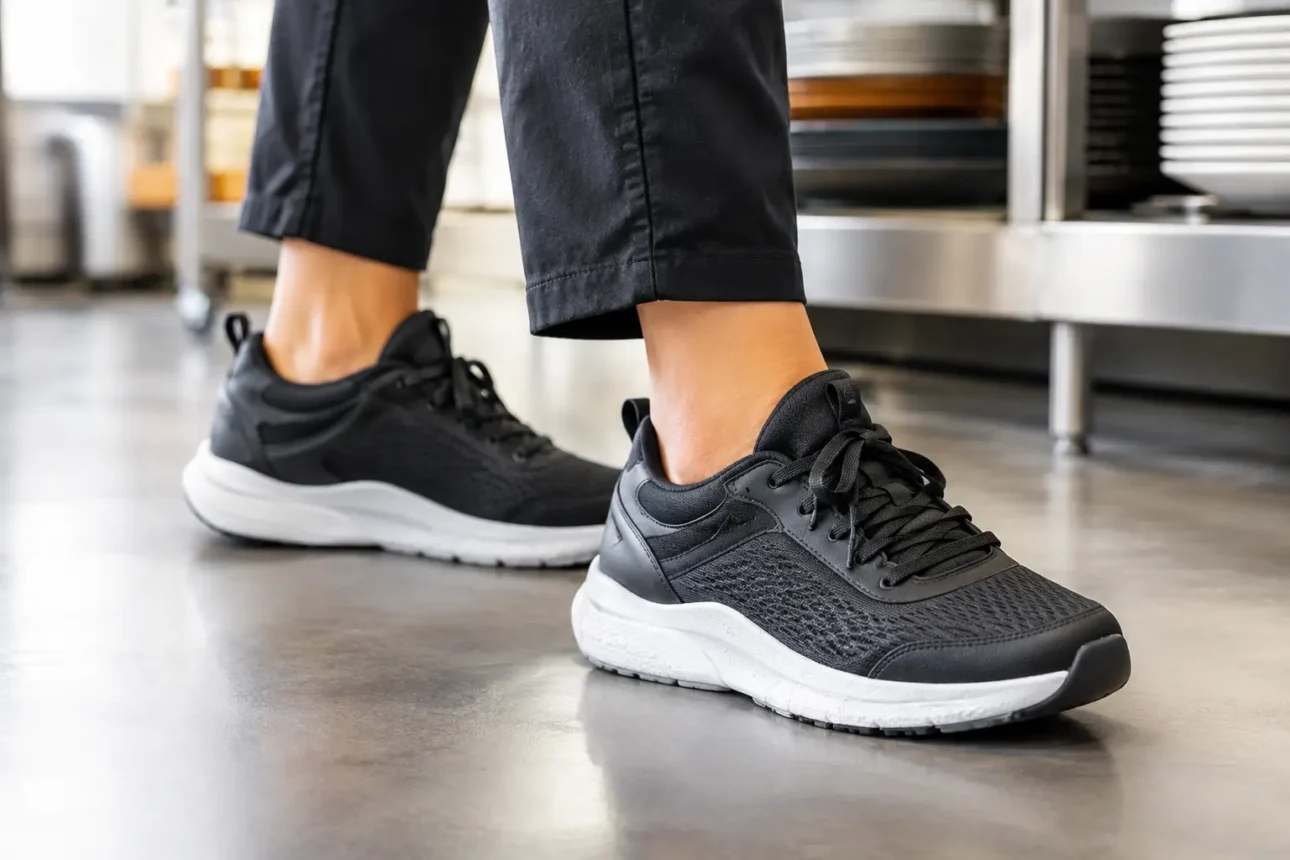
A restaurant floor tells the truth about a shoe fast. Concrete and tile do not care how clean your sneakers looked before work. Add spilled soda, grease near the line, tight turns behind the bar, and eight hours without sitting down. Restaurant shift sneakers need to do more than look decent with black pants. They need to stay planted, keep your feet from feeling wrecked, and survive being wiped down at the end of the night.
We would not pick a shoe for this job based on a logo or a trending colorway. Some of the best-looking sneakers are terrible for restaurant work. Flat soles, soft suede, and slippery outsoles belong on a casual day out, not a closing shift.
The first thing is grip. Not a vague claim about traction. We mean an outsole that still feels steady when the floor is damp, dusty, or marked up from a busy service. If your workplace requires slip-resistant footwear, follow that policy. A running shoe can have a grippy-looking sole and still not meet the standard your manager expects.
Then there is cushioning, but not the kind that feels like a mattress for ten minutes and unstable by hour four. You want enough foam to take the edge off hard floors, with a base that does not make your foot roll around when you pivot. Restaurant work is full of quick side steps and sudden stops. A tall, squishy sole can feel nice walking down the street, then feel sketchy when you are carrying plates around a corner.
Fit matters just as much. Your feet tend to swell through a long shift, especially in a hot kitchen. A shoe that is snug at 10 a.m. can start squeezing your toes by late afternoon. Leave a little room up front, lock down the heel, and do not assume you need to size up unless the shoe runs short. A shoe that is too big creates its own problem: your foot slides, your heel rubs, and now you have blisters halfway through the week.
Finally, think about the upper. Mesh breathes well, which is nice when the line is hot. It also absorbs spills and can be annoying to clean. Smooth synthetic materials and leather are easier to wipe down, but often run warmer. Neither choice is perfect. If you work front of house and spills are occasional, breathable mesh may be worth it. If you are around oil, sauces, and dishwater all day, an easy-clean upper is the smarter call.
We get why flat, low-profile sneakers are popular. They look sharp, work with almost anything, and do not scream “work shoe.” But most canvas-style classics and thin-soled retro pairs are rough on hard floors when you are standing for six to ten hours.
That does not mean every restaurant worker needs a huge running shoe with a giant sole. It means your shoe needs some actual underfoot support. A moderate amount of cushioning, a stable heel, and a sole with real rubber are usually a better bet than a fashion sneaker with a paper-thin midsole.
If your shift involves mostly hosting or serving in a polished dining room, you may want a cleaner, lower-profile look. That is fair. Look for an all-black or mostly black walking or running-inspired sneaker with a less bulky shape. You can keep the outfit clean without punishing your feet.
This is where people get caught out. More foam sounds better. Sometimes it is. But a soft shoe that sits high off the ground can make you feel less secure during fast movement, especially if your ankles tend to roll or you are constantly weaving through a crowded kitchen.
For a host stand, cashier shift, or a slower café job, a plush walking shoe can feel great. You are mostly moving forward, standing in place, and taking shorter steps. For a server, bartender, runner, or cook, we lean toward a shoe with medium cushioning and a wider, more grounded platform. You want comfort, but you also want to trust the shoe when you move fast.
Brands like New Balance, Brooks, Asics, Hoka, On, Adidas, Nike, and Puma all make pairs that can work for standing and walking. The logo is not the deciding factor. Within every brand, there are stable models, soft models, narrow models, and shoes that look good but are built mostly for casual wear. Check the specific sole, fit, and upper instead of buying a name.
A bartender has different needs from someone working prep. A bar floor can be wet, sticky, and full of quick pivots in a tight space. Kitchen work means heat, grease, and long periods planted in one area. A server may cover miles in a shift, while a host might stand in one spot with short bursts of walking.
For servers and runners, start with grip and a secure heel. You need a shoe that stays stable when you turn quickly with a tray or move around chairs. For kitchen staff, easy cleaning and slip resistance move to the top of the list. A white mesh running shoe is a bad idea here, no matter how comfortable it feels in the store.
For bartenders, look for a planted feel and a tough upper. You do not need the lightest shoe on earth. You need one that will not feel slippery when the mat is wet. For hosts and cashiers, cushioning may be the bigger priority, since standing still can be harder on your feet than walking.
If you work double shifts, consider having two pairs in rotation. This is not about collecting sneakers. It gives each pair time to air out and dry, and it stops you from relying on one beat-up shoe until the outsole is worn smooth. Your feet notice the difference.
A clean white pair has its place. A restaurant shift is usually not it.
Black sneakers hide scuffs, sauce marks, and the grime that comes with taking out trash after close. They also work with most dress codes. All-black is the safe move if your job is strict, but black with a small white midsole can still look clean if your manager is fine with it.
We would avoid suede for restaurant work unless you are only wearing the shoe for a short, low-risk front-of-house shift. Suede stains easily, hates moisture, and does not forgive a dropped ramekin of dressing. Leather or synthetic leather is not glamorous, but it wipes clean. Sometimes the less exciting option is simply worth it.
Do not judge a work shoe from the first thirty seconds. Try it on later in the day if you can, when your feet are closer to their shift size. Wear the socks you actually work in. Walk, turn, and stand still for a few minutes.
Pay attention to three spots: your toes, your heel, and the middle of your foot. Your toes should not touch the front when you step. Your heel should not lift with every stride. And the middle should feel supported, not squeezed. A shoe may loosen a little with wear, but it will not magically become wider in the exact place that is pinching you.
If you use insoles, bring them into the equation. A supportive insole can improve a basic pair, but it also takes up space. Do not stuff one into an already tight shoe and hope for the best. You will just create pressure on top of your foot.
Outsoles can lose grip before the upper looks finished. Foam can flatten out even when the shoe still looks clean from the side. If your feet are suddenly more tired after a normal shift, your knees ache more than usual, or you catch yourself sliding where you did not before, inspect the soles.
You do not need to replace sneakers on a fixed calendar. Your shifts, body weight, floor type, and how often you rotate pairs all change the timeline. But if the tread is worn down in the spots where you push off and turn, do not talk yourself into another few months. That is not saving money if it makes every shift worse.
The right pair will not make a Saturday night rush easy. Nothing will. But restaurant shift sneakers that grip well, fit right, and match the reality of your job let you focus on the shift instead of counting the minutes until you can take them off.