Cart
No products in the cart.
Buying shoes online should be easy. Then you order your usual size, the box shows up, and one shoe feels fine while the other feels like a bad decision. That is why a solid online shoe sizing guide matters. Not because sizing is mysterious, but because brands are all over the place and your “usual size” means less than people think.
We’ll say it straight. Most sizing problems come from two things: people guessing, and brands not fitting the same. A Nike running shoe, a New Balance retro pair, and a Hoka daily trainer can all say the same size and still feel different on foot. If you shop online, you need a better system than hope.
The biggest mistake is treating shoe size like a fixed fact. It isn’t. Your foot shape matters. The type of shoe matters. Even how you plan to wear it matters.
A lifestyle sneaker can feel good with a close fit because you’re mostly walking, sitting, and looking sharp. A running shoe usually needs a bit more room up front because feet swell and toes need space when you move. If you stand all day, a pair that feels snug at 9 a.m. might feel terrible by 5 p.m. That’s the stuff that actually matters.
And yes, sizing charts help. But charts alone are not enough. They give you a starting point, not the full answer.
If you are still ordering based on what size you wore in high school, stop doing that.
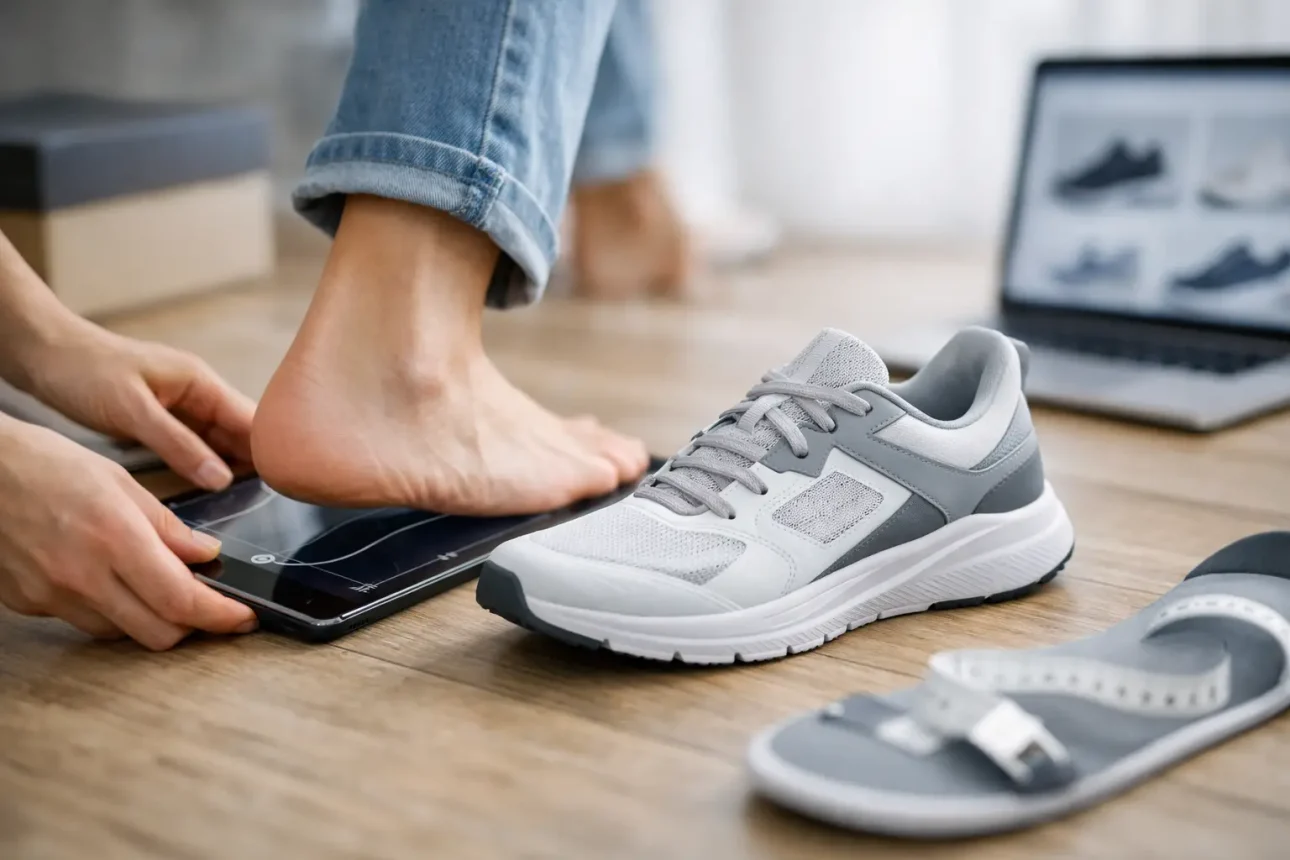
Measure both feet. Seriously. A lot of people have one foot slightly longer or wider than the other. You fit the bigger foot, not the smaller one. Put a sheet of paper on the floor against a wall, stand on it with your heel lightly touching the wall, and mark the tip of your longest toe. Then measure that length. Do this for both feet.
Do it wearing the kind of socks you’ll actually use with the shoe. Thick athletic socks can change the fit. Thin no-show socks can too. Measure at the end of the day if you can. Feet tend to be a bit larger then, and that gives you a more realistic fit for real life.
Width matters too, even though people ignore it until a shoe starts rubbing. If the sides of your foot usually spill over the midsole, or you often feel pressure near the little toe or forefoot, your issue may not be length. It may be width. Going up half a size sometimes helps, but not always. A longer shoe is not the same as a wider shoe. It just gives you extra dead space in front.
A lot of people stay stuck on one size because they don’t want to admit they need a different one in a certain brand. That makes no sense. Sizes are labels. Comfort is real.
Start with your foot length in inches or centimeters and compare it to the brand’s size chart for that specific shoe category if available. Running shoes and casual sneakers from the same brand do not always fit the same. Some brands are more consistent than others, but none are perfect.
If your measurement puts you between sizes, the answer depends on the shoe. For narrow shoes, performance shoes, or pairs known to run short, going up half a size is usually the safer call. For roomy retro sneakers or models with soft uppers that break in a bit, your regular size may be enough. This is where people get tripped up. There is no single rule that works every time.
This is where any online shoe sizing guide earns its keep. Brand name matters, but model shape matters even more.
Nike often fits a bit narrow, especially in sleeker running and lifestyle models. If your feet are wide, some Nike pairs can look great in photos and feel annoying after twenty minutes. Adidas is mixed. Some pairs fit true to size, while others feel snug in the midfoot. New Balance usually gives you a little more breathing room, which is one reason people keep going back to it. Hoka tends to have a more accommodating feel in many models, but not every upper is forgiving. Asics and Brooks are often solid if you want a secure fit without squeezing your forefoot. Puma and Onitsuka Tiger can run slim depending on the model.
That does not mean one brand is better for everyone. It means you should stop assuming your size transfers perfectly across labels. It often doesn’t.
A retro low-top and a max-cushion running shoe should not fit the same way. If you try to make them fit the same, one of them will feel wrong.
For casual everyday sneakers, we usually like about a thumb’s width of space at the toe, but not so much that your foot slides around. You want enough room to move, not enough room to swim. A close fit can look cleaner on foot, but too close gets old fast.
For running or long walking, a little extra room in the toe box is usually smarter. Your feet heat up, swell, and move forward. If your toes are already near the front when you first try them on, that’s not a good sign. A shoe can feel secure at the heel and midfoot while still giving your toes some space. That’s the sweet spot.
For standing all day, we’d take slightly roomy over slightly tight almost every time. Tight shoes do not get more fun after eight hours.
The first mistake is only checking the number on the box and ignoring width, shape, and use. The second is trying on shoes for thirty seconds and deciding they fit. Walk around. Stand in them. Pay attention to heel slip, toe pressure, and side squeeze.
Another mistake is assuming a shoe will stretch a lot. Some materials soften. Some barely move. Mesh can be forgiving. Structured overlays and stiff sidewalls usually are not. If a shoe is painful out of the box, don’t count on a miracle.
People also confuse snug with secure. A secure fit locks the heel and midfoot without crushing the forefoot. Snug everywhere is just tight.
This is the real-world question. If you’re between sizes, your choice should depend on shape and purpose.
If the shoe runs narrow, has a pointed shape, or you plan to use it for running or all-day wear, we’d usually lean up half a size. If the shoe already has a roomy toe box, soft upper, or a chunkier retro shape, staying with the lower size can make more sense.
If one foot is bigger, fit that one first. You can fine-tune the smaller side with socks or lacing. That works better than cramming the bigger foot into a size that was never going to work.
And if you already know you have wide feet, be honest about it. Do not keep forcing yourself into slimmer models just because they look clean online. Some shoes are worth the compromise. A lot are not.
Here’s our honest take. Size charts matter. So do brand tendencies. But the best results come from combining your actual measurements with a little pattern recognition. If a brand usually feels narrow on you, trust that. If a roomy New Balance in your regular size fits perfectly but a slim Nike never does, that is useful information. Use it.
Keep a note in your phone with the models you’ve owned, what size you wore, and how they fit. That sounds basic because it is, but it works. After a few pairs, you’ll start spotting what actually suits your feet instead of repeating the same expensive guess.
A clean sneaker is nice. One that still feels good after a full day is better. That’s the pair worth buying.