Cart
No products in the cart.
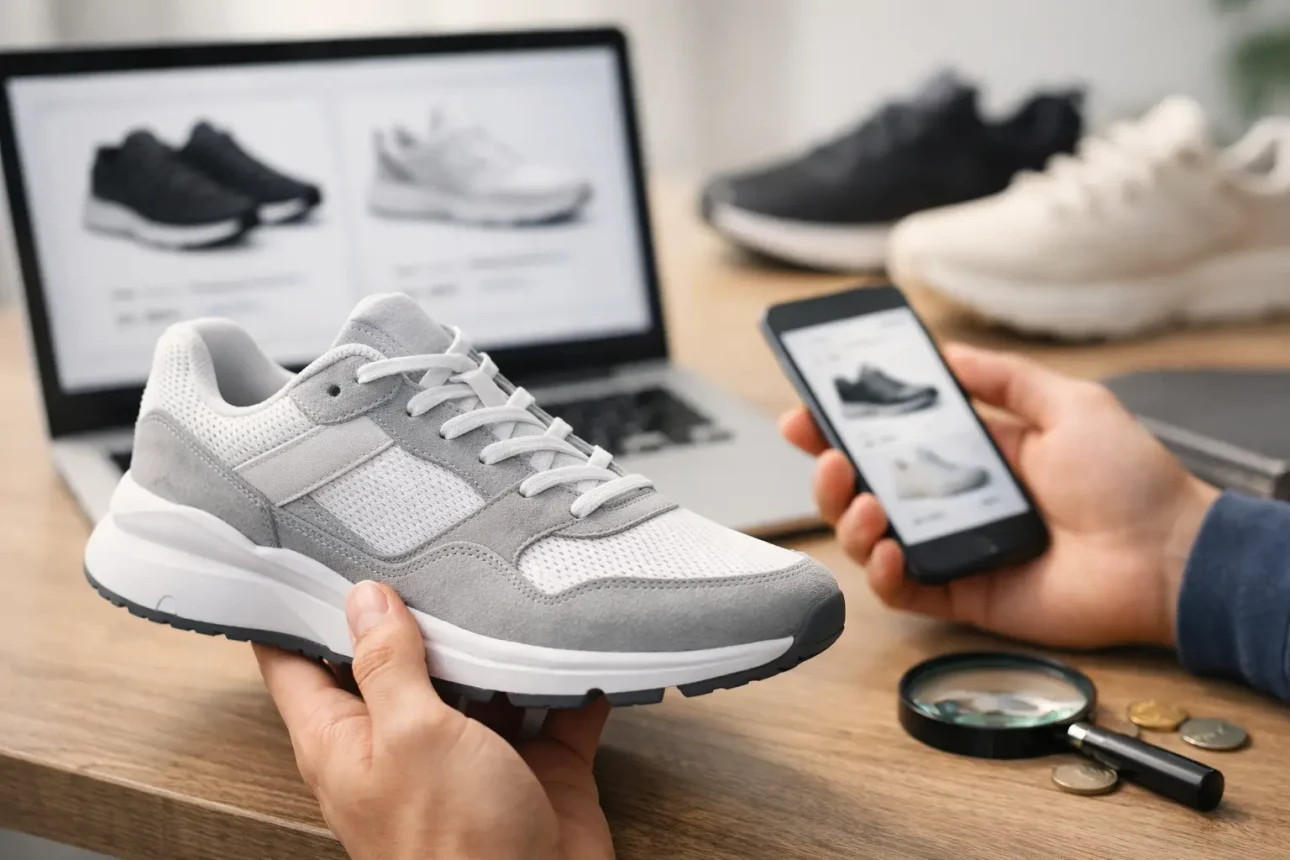
A pair of sneakers at $90 can end up costing more than the same pair listed at $110. That sounds backwards, but it happens all the time. If you want to know how to compare sneaker prices without getting tricked by shipping fees, weird sizing, or the wrong version of the shoe, you need to compare more than the number on the product page.
Most people price-check sneakers too fast. They search the model name, open a few tabs, and go with the lowest price. We get why. Nobody wants to overpay for a pair of New Balance, Adidas, Nike, or Asics when five stores seem to have the same shoe. The problem is they often do not have the same shoe. Same silhouette, maybe. Same value, not always.
The first thing we look at is the exact model. Not just the name. Not just “Air Max” or “990” or “Gel-Kayano.” Brands love using one family name across a bunch of versions that wear differently and cost differently. A Nike Air Max 90 is not an Air Max Excee. A New Balance 2002R is not a 1906R. They might sit in the same lane style-wise, but the price gap usually reflects real differences in build, materials, or demand.
If you’re serious about how to compare sneaker prices, check the product code. That little code matters more than the marketing copy. It tells you whether two stores are selling the exact same shoe or just something close enough to confuse you. This is where people get burned. One shop lists a leather version, another lists mesh, and both use the same casual product name. The cheaper one looks like a deal until it shows up and feels totally different.
Colorway matters too. This is one of the easiest ways stores look cheaper than they are. A loud color that nobody wants gets marked down hard. A clean white, black, gray, or simple retro colorway usually stays closer to full price. So if you’re comparing a beige pair to a neon pair and calling it the same deal, you’re not really comparing price. You’re comparing popularity.
This is where things get less fun but more useful. The number you see first is just the starting point. Real sneaker price means item cost, shipping, taxes if shown separately, and return cost if the fit is off.
Free shipping is not a bonus anymore. It changes the whole value. A store with a lower listed price but expensive shipping is not cheaper. Same with returns. If you are between sizes, return policy matters a lot. Saving $12 upfront does not feel smart when sending them back costs you $18.
Multi-currency stores can mess with your head too. A price can look lower because you’re reading it in another currency and not doing the full conversion in your head. Then your bank adds a foreign transaction fee and suddenly your “deal” is just average. Not a scam. Just bad math on your end.
We’d also say this plainly – if a price looks way too low on a current, popular sneaker, slow down. Maybe it is a good sale. Maybe it’s old stock. Maybe it’s a weird region release with limited sizes. Or maybe the store is not one you’d trust with your money. Cheap is only good when the shoe actually arrives and is what you ordered.
A lot of shoppers compare within a brand when they should compare across versions. That sounds obvious, but people still do it wrong. They decide they want “a Hoka” or “an Adidas lifestyle shoe” and then chase the lowest price. Better move is to ask what you’re actually wearing them for.
If you want a pair for daily wear, commuting, and standing around all day, a discounted performance runner is often better value than a full-price fashion sneaker. Not always better looking. But often better on foot by 5 p.m. On the flip side, some technical runners are overpriced if all you want is a clean pair with jeans. Paying extra for features you will never notice is still overpaying.
This is where honest comparison helps. Some shoes are expensive because they are genuinely better built. Others are expensive because people on social media decided they are cool this month. Those are not the same thing. If the shape is solid and the materials are decent, a less hyped model can be the smarter buy every time.
If two stores are within ten or fifteen bucks of each other, stop staring at the price and look at the details around it. That small gap is usually less important than sizing, stock, shipping speed, and return policy.
Sizing is a big one. A pair that’s known to run narrow, long, or stiff out of the box is riskier to buy from a store with annoying returns. We would rather pay a little more from a shop that makes exchanges easy than save a few dollars and get stuck with a pair that only feels okay for ten minutes at home.
Stock depth matters too. A low price on one leftover size is not really a useful deal unless it is your size. Same with display pricing that changes once you click in. If the advertised price is only for one unpopular color or one tiny size run, that is not the same as broad markdown pricing.
Then there is release timing. Older season pairs usually drop in price once newer colors land. That can be a great move if you do not care about being first. In fact, that’s often the sweet spot. You get the same shoe, less noise, better price. Unless the model is genuinely hard to find, waiting beats panic-buying.
Sale sections can be great. They can also be messy. Stores throw a lot of shoes into “sale” even when the discount is tiny or the better sizes are gone. We like to check the percentage off, but we care more about the starting price and whether the shoe was ever worth that original number.
Some sneakers live at fake full price and are almost always discounted somewhere. In that case, a 20% markdown is not special. It is just the normal market price wearing a sale tag. This happens a lot with certain lifestyle runners and seasonal colorways. Looks exciting. Usually isn’t.
A better sale is on a model that normally holds its price, especially in clean colors and common sizes. That’s where you know the discount is real. If you find a well-liked everyday pair from Brooks, On, Hoka, or New Balance with a real drop and normal size availability, that’s worth paying attention to.
You should also check whether final sale is involved. We do not love final sale unless you already know the shoe fits you. Sneakers are too inconsistent across brands for blind confidence. A size 10 in one brand can feel clean and roomy. In another, it feels like your toes signed up for a bad time.
This is the part people skip because it is less exciting than a discount sticker. But it is the whole point. A $140 pair you wear four times a week for a year can be a better buy than an $80 pair you stop wearing after two weeks because it feels flat, stiff, or looks weird with everything.
That does not mean expensive always wins. Far from it. Some expensive sneakers are all branding and no substance. We have all seen pairs that look good in photos and feel cheap in hand. But if a shoe fits your routine, holds up well, and keeps getting worn, its value goes up fast.
So ask yourself a blunt question. Are you buying for price, or are you buying for use? The right answer is usually both. A fair price on a shoe you will actually wear is the goal. Not the lowest number you can screenshot.
At Sneakerness, we think the smartest shoppers are the ones who stay a little skeptical. Check the code. Check the fees. Check the return terms. Then ask whether the shoe is really the one you want, or just the cheapest version of something close. A good sneaker deal should feel good before checkout and after a week on your feet.